Texas Leica
Another 6x9 Rangefinder
I have owned a medium format 6x9 rangefinder camera for several years and it is one of my favourite cameras. Of course shooting this format on 120 film is expensive, you only get 8 shots to a roll of film, but there are advantage, too. 6x9 is a huge negative, you can crop it to an X-Pan like 17x6, or a square at 6x6, or anywhere in between whilst still having a decent size image to work with. My 6x9 Zeiss Ikonta also fits in a coat pocket, which makes it a true "take anywhere" option.
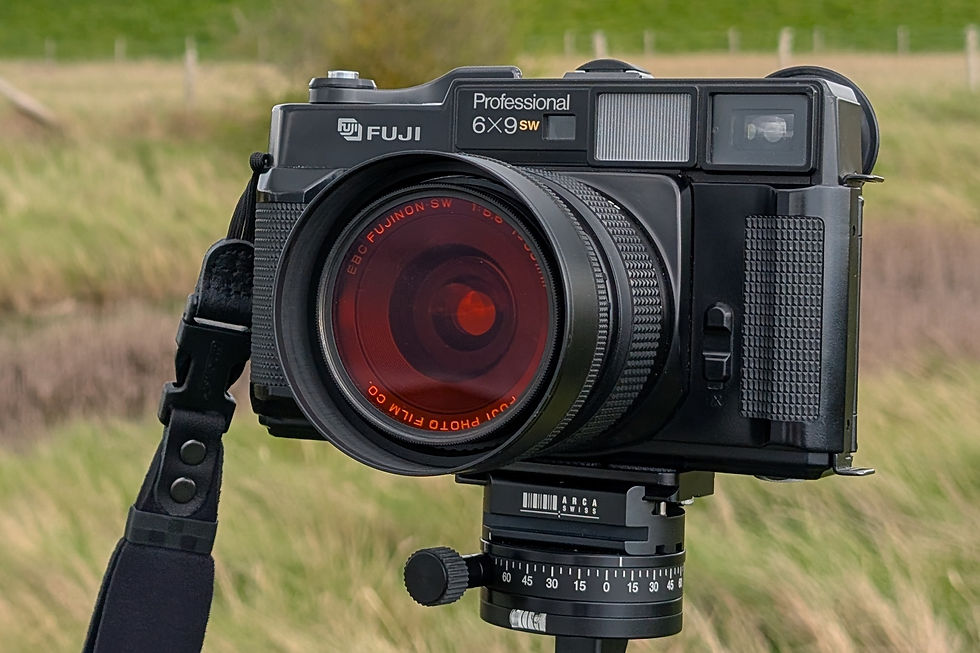
Although the Zeiss Ikonta and Fuji GSW690 are both 6x9 rangefinder cameras, they are very different. The Zeiss folds up small and is light, the Fuji is a brick, hence the "Texas Leica" nickname. The Zeiss has an f4.5 "Standard" 105mm lens whilst the Fuji has a wide angle (28mm equivalent) 65mm f5.6 lens. The rangefinder in the Fuji is coupled, that in the Zeiss is not. Both have all the exposure controls on the lens, with in-lens leaf shutters.
A size comparison of the Fuji GSW690 and the Zeiss Ikonta 6x9, folded and unfolded.
Why the Mk II?
For some time I've wanted a GSW690 because my experience with the Ikonta has shown that I like the format, but a wider lens would be useful, especially as the image can easily be cropped for a narrower field of view. I didn't want the 6x7 version because if I shoot 6x9 I can always crop to 6x7 anyway. I opted for the Mark II version because it has a number of improvements over the Mk I.
A hot shoe instead of a cold shoe
The shutter release has a lock - I don't want to waste shots when I only get 8 on a roll
A chequered grip pattern and strap lugs on each side make it more comfortable for me to use.
I chose not to buy the Mk III because I don't like the rubberised, "plastic fantastic" look. The MkIII is a solid metal camera under the new clothes, but I prefer the look of the older version. When my local camera dealer Canterbury Cameras had a GSW690 II for sale in great condition, how could I resist?
In Use
To me the camera doesn't feel too heavy, but I've used a Mamiya C330f outfit with several lenses and viewfinders in the past and still use a comprehensive Bronica SQAi outfit. In the long-run, it's a cheaper way of body-building than going to the gym! The viewfinder is bright with clear frame lines and a nice rangefinder spot. Mine's a bit dusty inside, but I've not yet decided whether it's bad enough to be worth the cost of a CLA. The film wind-on is smooth and easy, which is just as well as you need a double stroke to wind on. Some reviewers find the aperture and shutter controls in the front of the lens fiddly, but compared with those on a Zeiss Ikonta they are big and bold, not a problem for me. The lens hood pushes back a little too easily, brushing my sleeve against it is enough to make it crooked, but other than that it's a delight to use.

There's no "B" setting, instead you have to use "T", the shutter stays open until you change the shutter speed to something else. There's obviously a risk of moving the camera doing this, so it's best to put the lens cap carefully over the lens first. It's easy to hand hold at speeds down to 1/30th, due to the weight of the camera, wide lens and the leaf shutter. It's great when using filters with black and white film because you don't look through the lens, so composing and focussing is easy even with a really dark filter and I intend to use the camera for some infra-red work.
Features
There's no exposure meter, and hence no need for a battery! But the camera does have an exposure counter. It increases the count by one every ten shots, so my camera has only taken 1,100 pictures. That's 138 rolls of film, not a lot for a professional camera made between 1985 and 1992, which explains the excellent condition it's in. Apparently I should get it serviced when I get to 5,000 shots.

Results
The images are certainly sharp and clear, and being so big would look perfectly clean and digital with a slow fine-grain film. I tend to shoot HP5+ and develop it in 1:50 Rodinal to get the "film look". This wouldn't be a good combination on 35mm negatives but I like it on 6x6 and above. Shooting into the sun I did get a hexagonal flare, as shown in the third image below. But the sun was only just out of the shot, so I think that's acceptable.
Further Reading
In addition to the large number of YouTube reviews, you can read more about the camera in Tim Leyton's blog, here https://timlaytonfineart.com/fuji690/


Comments